
How to Fix Sticky Floors After Mopping: What Works in 2026
You mopped the whole kitchen. It took 20 minutes. And somehow, the floor feels worse than before you started: tacky underfoot, attracting every crumb and pet hair in a ten-foot radius.
If your floor is still sticky after mopping, you’re not imagining things, and you’re not bad at cleaning. Something specific is going wrong in your process, and once you identify it, the fix is usually fast.
We asked Vella’s lead housekeepers, the ones who clean 15+ homes a week across Dallas, Austin, Fort Worth, Plano, and Frisco, what actually causes sticky floors and how they eliminate the problem every single time.
Here’s what they told us.
Why Your Floors Are Sticky After Mopping: A Diagnostic Guide
“Sticky floors after mopping” isn’t one problem; it’s a symptom with several possible causes. Before you grab a mop again, figure out which one applies to you.
Cause #1: Too Much Cleaning Product
This is the number-one reason floors stay sticky after mopping, and it’s the mistake our housekeepers see most often in the homes they service. Most store-bought floor cleaners are concentrated. When you pour a generous splash into your mop bucket without measuring, you coat your floors with a thin layer of soap that never fully rinses away. That film dries sticky, then attracts dirt, so your floors look dirty again within a day.
The Test: Run a damp finger across your floor after it dries. If it feels slippery or leaves a streak, you’ve got product buildup.
Cause #2: Wrong Cleaner for Your Floor Type
A cleaner that works beautifully on tile can destroy a hardwood finish. Oil-based products on laminate leave a waxy residue. Multi-surface cleaners marketed as “works on everything” often work well on nothing. Each floor material has a different surface chemistry, and using the wrong product is one of the most common reasons for a sticky floor after mopping.
Quick reference:
- Hardwood: pH-neutral, no-wax cleaner only. Never use vinegar (it dulls the finish over time). Never steam.
- Laminate: Barely-damp mop with a laminate-specific spray. Excess water warps the boards and leaves residue.
- Tile and Grout: Alkaline cleaners work well here.
- Vinyl/LVP: Mild dish soap (a few drops) in warm water, or a vinyl-specific cleaner. Skip anything abrasive.
Cause #3: Dirty Mop Water
Think about what happens when you dip a mop into a bucket of water that’s already full of dissolved dirt, grease, and old soap. You’re painting that grimy mixture right back onto the floor. The water might look “mostly clean,” but the dissolved residue is invisible, and it’s exactly what causes that sticky film.
Cause #4: Hard Water (A Big One in Texas)
This is the cause most cleaning blogs skip, and it matters enormously if you live in the Dallas–Fort Worth metroplex or the Austin area.
Texas has some of the hardest water in the country; the state average is 224 ppm (classified as “very hard”), well above the national average of 100 ppm. Dallas water typically measures 140–160 mg/L of mineral content, and parts of the Austin metro area hit 260 mg/L or higher.
Those dissolved calcium and magnesium minerals don’t evaporate when your floor dries. They stay behind as a chalky, slightly tacky film. If you’ve ever noticed white residue on your faucets or shower doors, the same thing is happening on your floors; you just can’t see it as easily on a dark surface.
Cause #5: Not Rinsing After Mopping
Many people treat mopping as a one-pass job: soap water, mop, done. But if you skip the rinse pass, every molecule of cleaning product stays on the floor. Professional housekeepers always do at minimum two passes, one to clean, one to rinse, and that second pass is what separates sticky floors from clean ones.
Hate mopping? Let Vella handle it, book a clean.
The Exact Method Vella’s Housekeepers Use: Step-by-Step
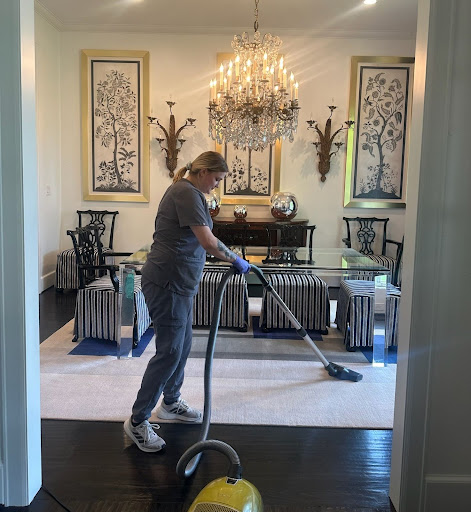
This is the process our team follows on every job. It works on tile, hardwood, laminate, vinyl, and luxury vinyl plank. Adjust your product choice based on floor type (see the reference above), but the method stays the same.
Step 1: Dry-Clean First
Before any liquid touches the floor, sweep or vacuum thoroughly. A microfiber dust mop is ideal because it traps fine particles instead of pushing them around. If you skip this step, you’re mixing loose dirt into your mop water and creating mud.
Step 2: Mix Your Solution Correctly
Fill your bucket with warm (not hot) water. Add your floor cleaner at the exact dilution ratio on the label, and if anything, err on the side of less. Our housekeepers typically use about half the recommended amount. For most floors, the water should look barely tinted, not sudsy.
Vella’s go-to for tile and vinyl:
A few drops of a plant-based dish soap (like Branch Basics diluted concentrate) in a gallon of warm water. That’s it. No fragrance boosters, no “shine enhancers,” no multi-purpose sprays.
For hardwood:
A pH-neutral hardwood floor cleaner. Spray directly onto a microfiber mop pad; never pour onto the floor or into a bucket. Hardwood and standing water are enemies.
Step 3: Wring the Mop Until It’s Almost Dry
This is the single most important technique for preventing sticky floors. Your mop should be damp, not dripping. When you wring it out, squeeze until no water drips. Then squeeze again. A waterlogged mop leaves too much solution on the surface, which is the primary cause of residue.
Our team uses flat microfiber mops (not string mops) for exactly this reason. They’re easier to wring to the right dampness level, and they don’t leave lint behind.
Step 4: Mop in Sections, Change Water Often
Work in roughly 6-by-6-foot sections, and swap your water the moment it looks murky. In a typical kitchen, that means changing water at least twice. Yes, it takes an extra minute. But dirty mop water is the second-biggest reason your floor is still sticky after mopping.
Step 5: Do a Clean-Water Rinse Pass
After you’ve mopped the entire floor with your cleaning solution, dump the bucket. Refill with clean warm water: no soap, no product, just water. Wring the mop nearly dry again and do one more pass over everything. This rinse removes the last traces of cleaner.
Step 6: Dry the Floor
Don’t let the floor air-dry if you can help it, especially in a humid Texas summer when evaporation is slow, and mineral deposits have more time to form. Run a dry microfiber mop or clean towel over the floor to pick up remaining moisture. This step takes two minutes and makes a noticeable difference.
This is exactly what our housekeepers do on every visit.
See Vella’s Basic Clean and book now.
Floor-by-Floor Cleaning Cheat Sheet
- Hardwood floors: Use a pH-neutral hardwood cleaner (Bona or similar), spray onto a microfiber pad, and damp-mop only. Never use vinegar, steam, or excess water. Buff dry immediately.
- Laminate floors: Spray a laminate-specific cleaner onto the mop pad; never pour water directly on laminate. Use minimal moisture. Dry with a towel promptly.
- Ceramic and porcelain tile: Warm water with a small amount of alkaline cleaner or a few drops of dish soap. Vinegar rinse is safe here. Mop grout lines in your regular deep-cleaning rotation.
- Vinyl and luxury vinyl plank (LVP): Warm water with a tiny amount of dish soap or vinyl-safe cleaner. Avoid abrasive pads. Vinegar rinse is safe. Dry after mopping.
- Natural stone (marble, travertine, slate): pH-neutral stone cleaner only. No vinegar, no lemon, no generic multi-surface products. These surfaces are acid-sensitive and will etch.
Frequently Asked Questions
How often should I mop my floors?
For most households, once a week in the kitchen and every two weeks elsewhere is a good baseline. Homes with pets, kids, or heavy foot traffic may need more frequent mopping. You can also use eco-friendly products to keep things simple and safe between deeper cleans.
Why is my floor sticky even though I barely used any cleaner?
If you’ve ruled out product overuse, the culprit is likely hard water, a dirty mop, or residue from previous cleanings that has built up over time. Try a plain hot-water-only mop session with a clean microfiber pad to strip away old buildup, then start fresh with the method above.
Is a steam mop safe for all floors?
Steam mops are effective on sealed tile and some vinyl floors. They should never be used on hardwood, laminate, or unsealed surfaces.
Should I use a string mop or a flat mop?
Flat microfiber mops are better for virtually every floor type. They’re easier to wring dry (critical for preventing sticky residue), they don’t leave lint, and the pads are machine-washable.
When to Call in Vella
If your floors have layers of old product buildup, if you’re dealing with stubborn hard water staining, or if you’d simply rather spend your Saturday doing something other than perfecting your mop technique, that’s what we’re here for.
Vella’s housekeepers serve Dallas, Austin, Fort Worth, Plano, Frisco, and surrounding communities. Every clean includes proper floor care using the exact method described above, with products matched to your specific floor type.
Get a professionally clean home. Take our Clean Quiz, and we’ll match you with the right service.